Starvard University · History
How America got here: colonies, revolution, civil war, industrial boom, world wars, and civil rights. The honest story, in plain English.

The whole course in brief
Twelve lessons, twelve big ideas.
The twelve lessons
Lesson 1
Long before Europeans arrived, millions of Native people lived across the continent in hundreds of nations with their own governments, trade networks, and cultures: the Iroquois Confederacy, the Mississippian cities, the Pueblo peoples, and many more. "Discovery" is the wrong word. It was an encounter between worlds, and a catastrophic one for the people already here.
Disease did most of the early destroying. Europeans carried smallpox, measles, and influenza to populations with no immunity, and epidemics swept ahead of actual settlement, killing staggering numbers. When the colonists arrived, they walked into a continent already emptied by plague. That context matters for everything that follows.
Lesson 2
By the mid-1700s, thirteen British colonies stretched along the Atlantic, each with its own character: Puritan New England, the diverse middle colonies, the plantation South. What united them was self-government. For generations London mostly left them alone, and colonial assemblies got used to running their own affairs.

Then Britain tried to make the colonies pay for the French and Indian War, with taxes and trade rules decided in Parliament, where colonists had no representation. "No taxation without representation" was not a slogan about money. It was about who gets to decide. A people used to governing themselves were told they were subjects, not citizens. The powder keg was packed.
Lesson 3
The war for independence ran from 1775 to 1783, and the Americans should have lost. Britain had the world's best army and navy; the colonists had a ragtag force, little money, and deep divisions (plenty of colonists stayed loyal to the Crown). What they had was George Washington, who kept the army alive through defeats, and France, which supplied money, ships, and troops to weaken its British rival.
The Declaration of Independence (1776) was the war's mission statement: "all men are created equal," with rights to life, liberty, and the pursuit of happiness. It was radical, it was inspiring, and it was written by a slaveholder in a slaveholding society. That contradiction, between the promise and the practice, would drive the next two centuries of American history.
Lesson 4
The first attempt at government, the Articles of Confederation, was too weak to work: no power to tax, no power to enforce. So in 1787, delegates met in Philadelphia and wrote the Constitution: three branches with checks and balances, federalism splitting power between states and the nation, and a Bill of Rights added to protect individual liberties.
It was brilliant and it was a dodge. To keep slave states in the union, the founders compromised on slavery repeatedly, including the notorious Three-Fifths Compromise. They built a machine for self-government while leaving its deepest moral rot unaddressed. The document survived because it could be amended. It would need to be.
Lesson 5
The 1800s were the century of expansion. The Louisiana Purchase (1803) doubled the country's size overnight. Settlers poured west, driven by land hunger and the ideology of Manifest Destiny: the belief that America was destined to span the continent. Railroads stitched it together; the telegraph and then the telephone shrank it.
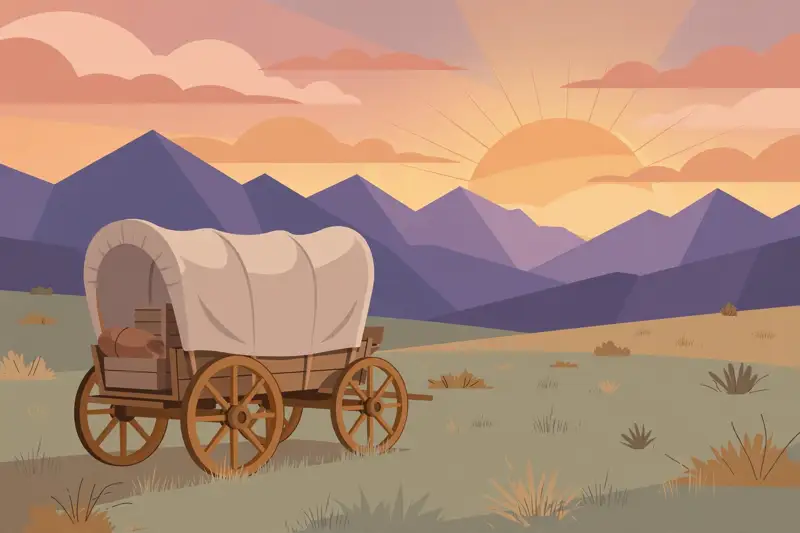
The cost was paid by Native nations: broken treaties, forced removals like the Trail of Tears, wars of extermination, and by the 1890s, confinement to reservations. The same decades built the continental nation and destroyed the continent's first nations. Both facts are true at once, and honest history holds both.
Lesson 6
By 1860 the country had split into two economies and two moral universes: an industrializing North and a South built on enslaved labor. The immediate trigger was Lincoln's election; the deep cause was slavery, which the founders had dodged and which westward expansion kept forcing back onto the agenda. Eleven Southern states seceded. The war that followed (1861-1865) killed about 750,000 Americans, more than all other American wars combined.
The Union won, and the war settled two questions. First, the Union is permanent; states cannot leave. Second, slavery is over: the Emancipation Proclamation (1863) and the 13th Amendment (1865) ended it legally. Lincoln did not live to see the peace; he was assassinated days after the war ended. The hardest part, what freedom would actually mean, was still ahead.
Lesson 7
After the war came Reconstruction: the attempt to build a multiracial democracy in the South. The 14th Amendment guaranteed equal protection and citizenship; the 15th guaranteed Black men the vote. For a brief moment it worked: Black Americans voted, held office, and built schools and businesses across the South.
Then the country quit. Federal troops withdrew in 1877, and Southern states built Jim Crow: segregation laws, voter suppression, and terror enforced by groups like the Klan. The Supreme Court blessed "separate but equal" in Plessy v. Ferguson (1896). The promises of the amendments sat unenforced for nearly a century. It remains the great American cautionary tale: rights on paper mean nothing without the will to enforce them.
Lesson 8
Between the Civil War and World War I, America industrialized at a speed the world had never seen. Railroads, steel, oil, electricity, the telephone: fortunes were built by Carnegie, Rockefeller, and Ford, and millions of immigrants poured in to power the factories. By 1900 America was the world's largest economy.
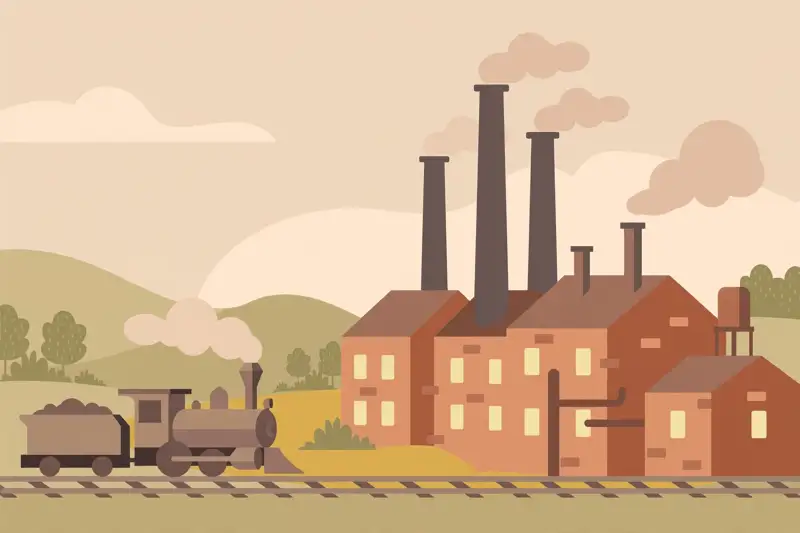
The boom had a brutal underside: child labor, 12-hour days, company towns, violent strike-breaking. Workers organized unions and fought, literally, for the weekend, the eight-hour day, and safety laws. The Progressive Era answered with antitrust laws, food and drug regulation, and the first real limits on corporate power. Prosperity and reform grew up together, each forcing the other.
Lesson 9
America tried to sit out both world wars and got pulled into both. World War I (1917) made America a creditor nation and a player. World War II (1941-1945) made it the superpower: American industry was the arsenal of democracy, American troops fought across two oceans, and the war ended with the atomic bomb, a weapon that changed everything about war forever.
The war's domestic effects were just as big. It ended the Great Depression, pulled women and Black Americans into industrial jobs, and created the GI Bill, which built the modern middle class through college and homeownership. It also interned Japanese Americans in camps, a shame the country took decades to acknowledge. Victory abroad did not mean justice at home.
Lesson 10
From 1945 to 1991, America faced off against the Soviet Union in a struggle that touched everything: proxy wars in Korea and Vietnam, the nuclear arms race, the space race, and at home, McCarthyism's hunt for communists and a military-industrial complex Eisenhower himself warned about. The Cold War was the weather system an entire generation lived under.
It also drove progress in strange ways. The space race put humans on the Moon. Defense spending built the interstate highways and seeded the internet. And the contradiction of fighting for freedom abroad while denying it to Black Americans at home became impossible to ignore, which is exactly what the civil rights movement used as leverage.
Lesson 11
A century after Reconstruction's betrayal, Black Americans organized one of history's most effective movements. The strategy was moral jiu-jitsu: nonviolent protest that forced violent overreaction into the cameras, making the country watch what segregation really looked like. Montgomery, Little Rock, Birmingham, Selma: each confrontation moved the needle.
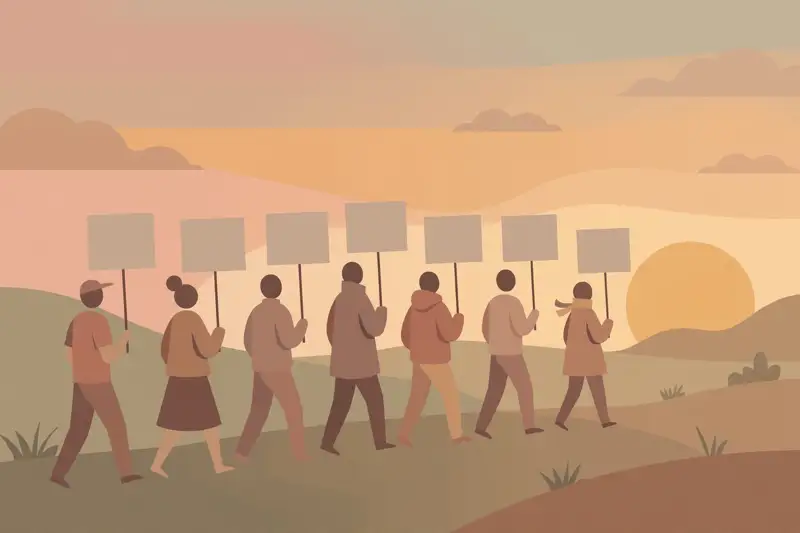
It worked. Brown v. Board (1954) killed "separate but equal" in schools. The Civil Rights Act (1964) and Voting Rights Act (1965) finally enforced the promises of the 1860s. Leaders like Martin Luther King Jr., Rosa Parks, and John Lewis paid with their safety and, for some, their lives. The lesson: ordinary people, organized and disciplined, can force a country to keep its promises.
Lesson 12
The Cold War ended, the internet arrived, and America entered a new argument with itself: about inequality, immigration, policing, guns, climate, and what the founding promises mean now. The pattern of American history is not a straight line of progress. It is a fight between the ideals and the reality, with advances, backlashes, and advances again.
That is the honest takeaway of this course. America was founded on a world-changing idea, that all people are created equal, by people who did not live it. Every generation since has been asked the same question: will you close the gap between the promise and the practice? The answer is still being written, and you are one of the authors.
Graduation
Colonies to revolution, a Constitution that could be amended, a continent taken, a war that ended slavery, a promise betrayed and then, a century later, partly kept. American history is not a museum piece. It is an ongoing argument about what "all men are created equal" actually requires. You know the story now. The next chapter has your name in it.
Keep learning
This course is part of Starvard University, striving for greatness.
A note on accuracy: Much of what you read at Starvard was created with help from AI agents, working alongside people. We check what we can, but we cannot guarantee that everything here is true, current, or complete. If something really matters, your health, your money, a grade, a job, please verify it with a trusted source before you rely on it.